Ovens · Cooktops · Wall units · Induction
Oven and Range Repair in Lynnwood, Shoreline & Everett, WA
Bake taking forever to preheat, a cooktop igniter ticking away with no flame, a radiant burner glowing red on every setting? Our technicians repair cooktops, wall ovens and ranges, gas or electric, in Lynnwood, Edmonds, Mill Creek and Everett.
- Diagnostic fee quoted on our callback, part of the repair price on your yes
- A written figure on paper before a single tool comes out
- Visits Monday to Sunday, many the same day you phone
- WA-licensed appliance repair
- LG and Whirlpool authorized service
- EPA 608 Universal refrigerant certification
- Sealed-system work done at your address
- On the road seven days, 8 to 7
- Smell of gasEveryone out, then phone from the street
- Electric and inductionElements, switches, sensors, boards and cooling fans
- Wall ovensSingle, double and combination built-in units
Ranges, ovens & cooktops
How ranges and ovens fail
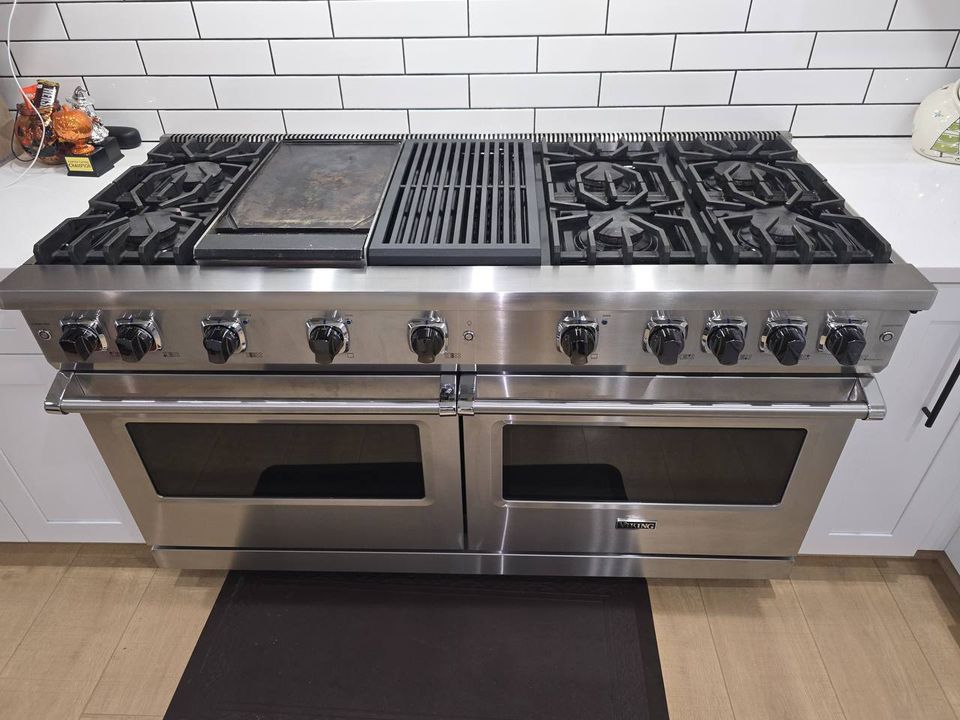
Gas and electric ovens break down in different ways. In a gas oven, a glow-bar igniter sits beside the burner and is wired in series with the safety valve, which opens only when enough current flows through the igniter. Aging glow bars still turn orange but pass too little current, so ignition drags on or never comes. Electric ovens heat with a bake element along the floor of the cavity and a broil element overhead, switched by relays on the control board and governed by a temperature sensor. Cooktops differ again: spark igniters under gas burners, infinite switches and radiant elements beneath a glass top, and induction coils, power boards and cooling fans in induction models. Because many symptoms overlap, our technicians measure current, resistance and voltage at the part, and the supply comes first.
A kitchen’s range says something about the house it sits in. Gas piping tends to follow gas heat, so gas cooking is likelier in Mill Creek, where about 57 percent of households heat with gas, in Edmonds at about half, and in Shoreline at around 44 percent. Lynnwood and Mountlake Terrace sit near a third, and Everett, where about 68 percent of homes use electric heat, is mostly coil and glass-top territory. Remodels bring wall ovens and induction cooktops from Bosch, Café, GE, KitchenAid, Miele and Thermador, while rentals rely on Frigidaire, GE, LG, Samsung and Whirlpool slide-in and standard ranges. Self-cleaning punishes all of them: that long, scorching cycle is when thermal fuses, lock motors and control boards most often give out.
Symptoms
Range and oven trouble we repair
Gas oven slow to light
When the glow bar shines for a minute or longer before the burner catches, or shines with no flame at all, it is almost always passing too little current for the valve. An amp clamp on its wire tells us; if the reading falls short, the igniter gets replaced, not the valve, which seldom fails.
Electric oven will not bake
Broil heats but bake stays cold? The lower element has probably burned open, and often you can see the blistered or split spot. If neither element warms, suspect a relay on the control board, a thermal fuse, or a missing half of the 240-volt feed. Each gets a meter test before any part is ordered.
Temperatures running hot or cold
A sensor that reads wrong makes cakes sink and roasts dry out. We measure the oven sensor’s resistance at room temperature against the maker’s chart, check its wiring at the board, and verify with a thermometer in the cavity. Small offsets can often be corrected in the oven’s settings without replacing anything.
Burner clicking nonstop
Constant clicking on a gas cooktop usually follows a boilover or a wet cleaning: moisture inside a spark switch or around an electrode keeps the module firing. Misaligned burner caps cause weak or uneven flames. We dry out and meter the switches, reseat the caps, and replace a shorted switch or spark module where needed.
Glass-top burner won’t turn down
When a radiant element glows red at every setting, or never warms, the infinite switch behind its knob has usually failed, or the element itself has broken. A cracked glass top is sold as a replacement part. Induction zones that ignore a pan point at the cookware, a stalled fan or the power board, and testing tells us which.
Door locked after self-clean
When the door stays latched after a cleaning cycle even though the oven has cooled, the lock motor or its switch has failed, or the board never sent the release. That same heat often blows a thermal fuse and leaves the display dark. We release the latch, then test the fuse and the board.
Stop by stop
Seven stops on a repair run
Each stop is a machine we fix most weeks. Ride the line or tap a stop.
Stop 1 of 7
Ranges and cooktops
An oven element that never reddens, a burner that clicks without a flame.
Range and oven repair page →
Before you call
Range checks before you book
- Make sure the oven is not in control lock, delay start or Sabbath mode; the manual explains how to clear each one.
- After cleaning a gas cooktop, let the burner parts dry fully and seat each cap flat on its base.
- Check the breaker panel; a range uses a double breaker, and one tripped half can kill part of the range.
- For induction, hold a magnet to the pan’s base; if it does not stick firmly, the cooktop cannot detect it.
- Smell gas? Forget the checklist: get everyone out, and once on the street, ring 911 or your gas utility.
By town
Ranges and ovens in each town
Lynnwood’s City Center apartments and condos run mostly electric ranges, many with coil or glass-top surfaces and self-clean ovens that see heavy use. In Mountlake Terrace, houses dating to the 1950s and 1960s usually keep a modest electric range on the original circuit, and that circuit deserves a check. Shoreline, with more gas heat than most of the six, has plenty of gas ranges in ramblers around Richmond Highlands and Ridgecrest. Edmonds view homes and Esperance houses, where gas heat is common, bring gas cooktops and double wall ovens. Mill Creek’s gas lines feed many pro-style ranges and wall ovens. Everett stays mostly electric, from Silver Lake to Evergreen Way.
Repair or replace
Repairing a range versus replacing it
A range or wall oven can serve for decades, and its usual casualties, igniters, elements, sensors, switches, lock motors and fuses, are sensible repairs. A control board costs more yet still earns its keep on a good oven, especially a built-in wall oven whose replacement would mean refitting the cabinetry. Replacement wins when rust has chewed through the oven liner, when a cracked glass top belongs to a model whose top is out of production, or when several major parts fail at once on an old range. While coverage lasts, an LG or Whirlpool-family range gets its covered repair from us as authorized service; for other makers, go to the maker first. Say no to our repair and the diagnosis is the one item billed.
Questions
Range or oven repair questions
We smell gas around the range. What do we do?
Everybody leaves the house, right now, without lighting anything, flipping switches or turning a knob on the range. Out in the open air, phone 911 or your gas utility, not before. When the utility has checked the house and called it safe, you can book a visit and we can test the burners, valves, regulator and connections on the range before anyone cooks on it again.
Can you fix induction cooktops in Mill Creek and Edmonds homes?
Yes. Induction turns up in remodeled kitchens in both towns, and the faults we meet are mostly a stalled cooling fan, a failed power board, or a cooking zone that refuses to detect the pan. The technician reads any error code, tests the fans and boards, and checks your cookware with a magnet before blaming a part.
Can a glass cooktop be fixed if it is cracked?
Usually, yes. Most current models list the glass top as a separate part, and the technician fits it along with any element or switch hurt in the same mishap. Stop cooking on cracked glass until then, since spills can seep through to the wiring. If an older model’s glass is no longer available, you will hear that before spending anything.
My Everett apartment range works on top but the oven is dead. Is that the wiring?
Usually not, though we check. Losing half of the 240-volt feed tends to make a range act oddly, such as a lit clock with no heat anywhere. When only the oven quits, a bake element, relay or thermal fuse is the more likely cause. The technician measures the supply first; if building wiring turns out to be at fault, that work belongs to an electrician, and we will say so to you and your landlord.
Does it matter who pointed me your way?
Every customer is priced the same way, whoever pointed you our way and whichever town you live in. The range repair gets one written price from the technician, the diagnostic fee is identical everywhere we go, and you see it all on paper before you agree to anything.
Can you fix a double wall oven when only one cavity heats?
Yes. In a double wall oven each cavity has its own elements, sensor and lock, while the two share a control board and a cooling fan. When one side quits, the fault is usually in that cavity’s element, sensor or relay rather than the shared parts. The technician pulls the unit from the cabinet only when access requires it and protects the trim.
Range, Oven and Cooktop Repair by town
Other appliances
Start with a diagnostic visit
Diagnosing a range, oven or cooktop carries a fee, quoted when you call. Approve the fix and that amount belongs to the written price instead of a separate line; refuse and only the diagnostic is billed.