Washers · Front-load · Top-load · Stacked
Washer Repair in Lynnwood, Shoreline & Everett, WA
Drum still sloshing after the cycle, a front-loader door that refuses to release, or suds spilling from the drawer? We repair washers in Lynnwood, Everett and the towns between, and every diagnosis starts with meter readings at the part.
- Diagnostic fee quoted on our callback, part of the repair price on your yes
- A written figure on paper before a single tool comes out
- Visits Monday to Sunday, many the same day you phone
- WA-licensed appliance repair
- LG and Whirlpool authorized service
- EPA 608 Universal refrigerant certification
- Sealed-system work done at your address
- On the road seven days, 8 to 7
- Soft waterMost homes here need less detergent than labeled
- ModelsFront-load, top-load, stacked pairs and laundry centers
- BrandsWhirlpool, Maytag, LG, Samsung, Speed Queen, Electrolux and more

Washers
How a washer fails, and why soft water matters
A washer has a short list of jobs: fill, agitate or tumble, drain and spin. Each job has its own set of parts. The inlet valve opens on a signal from the control board and fills through a small screen at the hose connection. A pressure switch or water-level sensor reports how deep the water is. A motor, direct-drive or belt-driven, turns the drum or agitator, with a coupler, clutch or shifter on many top-loaders. The drain pump pushes water out past a filter that catches socks and coins, and a door lock or lid lock holds things shut during spin. Springs and dampers soak up the shaking. When a cycle stalls, the error code and the step where it stopped narrow the search to two or three parts, and the meter settles it.
Water across our area is unusually soft. Five of the six towns draw from Spada Lake on the Sultan River, and Shoreline gets Seattle’s Tolt River supply, so mineral scale almost never clogs a washer here. What we find instead is too much soap. High-efficiency machines use little water, and in soft water a normal capful builds a wall of foam that triggers a suds code, slows the spin, gums up the dispenser drawer and leaves a sour film in the door boot. Add a damp marine winter and a laundry closet with the door kept shut, and front-load gaskets grow mildew. Stacked units squeezed into Lynnwood and Everett apartments have their own pattern, mostly drain pumps and door locks worked hard by small, frequent loads.
Symptoms
Washer problems our technicians fix
Gray water still in the drum
A front-loader that ends with standing water usually has a clogged pump filter, a sock lodged in the drain hose, or a pump motor that hums but cannot turn. Top-loaders can also siphon or back up when the drain hose is pushed far down the standpipe. We open the trap, test the pump windings and check the hose.
Foam pouring from the drawer
With water this soft, the usual cause is detergent, not a broken part. Too much soap foams over, the board pauses to let suds settle, and the cycle runs long or ends with wet clothes. We confirm the inlet valve and drain are healthy, then suggest a dose and a cleaning cycle to reset the machine.
Door stays locked
When a front-loader will not release its door, it either thinks water remains in the tub or the lock assembly has failed. We check the pressure sensor reading, the drain, and the lock’s switch and solenoid with a meter. Forcing the handle tends to snap the latch, so leave it for the visit.
Roaring or grinding in spin
A roar that climbs with spin speed points at worn tub bearings, often after a seal has leaked for months. On front-loaders the aluminum spider arm on the back of the drum can corrode as well. Bearing work is major, so we show you the play in the drum and talk through it against replacement.
Top-loader hums, no agitation
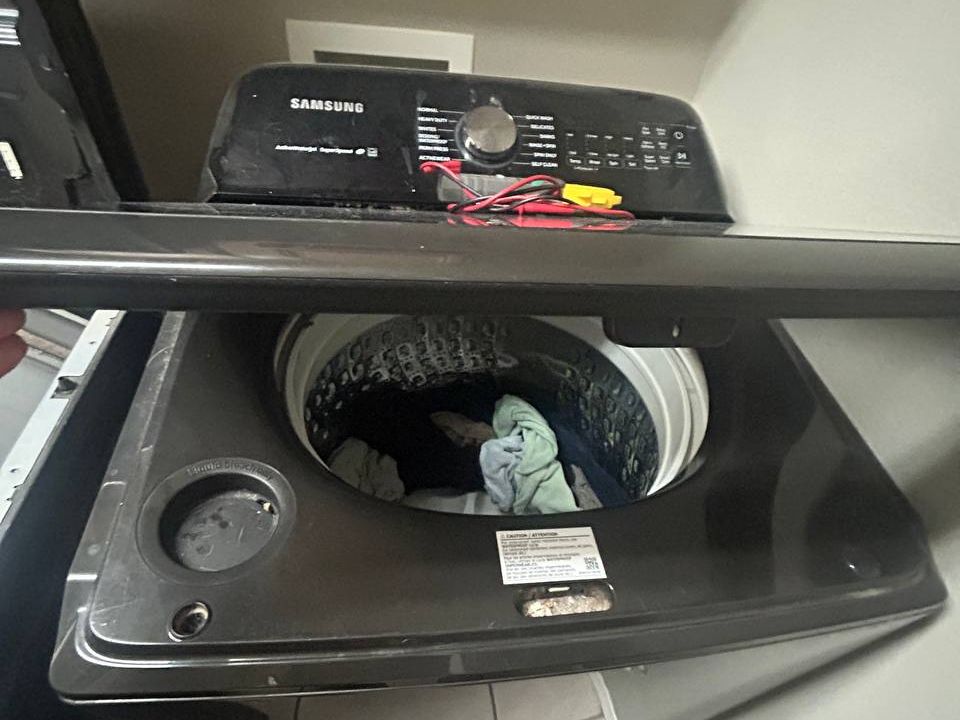
A hum with no movement on an older direct-drive top-loader often means a split motor coupler; on newer impeller models it may be the shifter or a lid lock that refuses to engage. Worn agitator dogs leave the upper half spinning loosely. We open the cabinet or console, inspect and test, then write one price.
Musty boot, black spots
Mildew in a front-load door boot grows where water and soap residue sit after the last cycle. If cleaning will not lift it, or the boot has torn and drips, we replace the boot and check for a slow pump-out that leaves water behind. Then we talk about detergent and airing the drum out.
Stop by stop
Seven stops on a repair run
Each stop is a machine we fix most weeks. Ride the line or tap a stop.
Stop 1 of 7
Washers
Water stranded in the drum, a lid lock that blinks, a spin that never gets going.
Washer repair page →




Before you call
Before you call about your washer
- Open both the hot and cold spigots behind the machine all the way, and straighten any kinks in the fill hoses.
- Measure detergent instead of pouring; our soft local water lets a small dose of HE detergent clean a full load.
- Check the breaker and the outlet, and confirm the plug is seated firmly after any move or cleaning.
- Spread out a heavy, lopsided load such as a single blanket or bath mat, then try the spin again.
- If the manual shows a pump filter behind a front panel, spread towels and set out a baking dish before unscrewing it.
By town
Washers along our six-town route
Lynnwood’s stacked washers, tucked into closets in City Center apartments and condos, wear out door locks and drain pumps under constant use. Mountlake Terrace houses built in the 1950s and 1960s often keep an older top-loader in a utility room, where couplers and lid switches are the usual failures. Shoreline ramblers put many laundries in a garage or basement, and winter damp there feeds gasket mildew. Edmonds remodels near the Bowl and Five Corners bring quieter Bosch, Miele and Electrolux front-loaders whose pump filters need regular clearing. Mill Creek’s 1980s and 1990s houses favor big front-load pairs on pedestals. In south Everett, laundry centers in rentals off Evergreen Way and Everett Mall Way see heavy use.
Repair or replace
Repair the washer or buy a new one
Door locks, pumps, lid switches, inlet valves, couplers, shock absorbers and control boards are all reasonable repairs on a washer that still has a sound tub. Bearings are where the math changes. On many front-loaders the bearing sits inside a sealed outer tub that has to be replaced as one assembly, which makes it one of the costliest jobs a washer can need. If the machine has reached the tail end of its service life, or the spider arm has corroded through, we will say so, and the visit closes with nothing owed beyond the diagnosis. Under warranty still? LG and Whirlpool-family washers get the covered repair from us as authorized service; other makers should be asked first.
Questions
Washer repair questions
Why does my Everett front-loader smell sour even after a cleaning cycle?
In soft water, leftover detergent and fabric softener collect in the door boot and under the drum, where they feed mildew through a damp winter. Run the machine’s hottest cleaning cycle with a washer cleaner tablet, wipe the folds of the boot, prop the door open after each wash and use less soap. If the odor returns within a week, the drain may be slow and worth a look.
Do washers in Lynnwood really need less detergent?
Yes. Lynnwood’s Spada Lake water is exceptionally soft, so soap dissolves and foams easily. A small measured dose of HE detergent, or a single pod for a full load, is usually plenty. Overdosing brings suds codes, longer cycles, damp clothes and a gummy dispenser. If the machine still flags suds even with a light dose, the cause may be a slow drain or a faulty pressure sensor.
Do you repair stacked washer and dryer units in condos?
Yes. Stacked sets and single-frame laundry centers fill closets in apartments and condos all over our area. The technician brings floor pads to ease the machine from its closet and checks the hoses and the dryer vent connection at the same time. Some repairs on a laundry center need the dryer section lifted or opened, which we plan before starting so the closet stays tidy.
My washer fills slowly. Is it hard water buildup?
Almost never here. Both the Spada Lake water and Shoreline’s Seattle supply are soft, so scale rarely forms. Slow filling usually means a clogged screen inside the hose connection, a weak inlet valve coil, a supply valve left partly closed, or low house pressure. We check each with the meter and a quick flow test, then clean or replace whatever is restricting the water.
Will you repair a Samsung or LG washer showing an error code?
Yes. Tell us the code by phone or enter it on the request page, plus the model number printed on the label around the door opening or on the rear panel. A code points at a system, such as draining or the door lock, rather than one part, so the technician still confirms with the meter before naming what failed.
Is the washer price the same whoever sent me?
The washer price works the same way for everyone, whoever sent you. The diagnostic fee is identical in all six towns, and the repair figure appears in writing for you to read before you give the go-ahead.
Start with a diagnostic visit
We quote the washer diagnosis fee on the phone. Agree to the work and its written price has that charge built in; say no and the bill stops with the diagnosis.